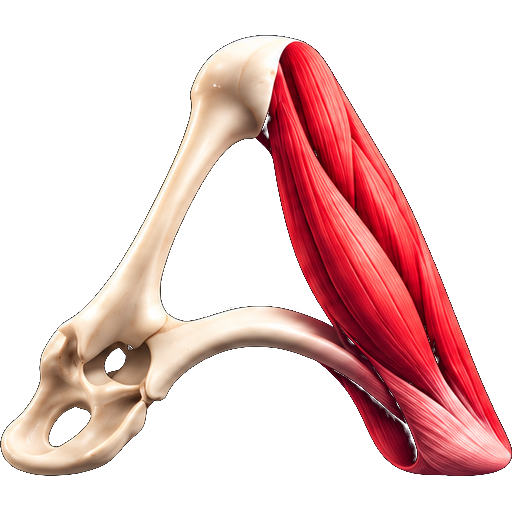
Abductor pollicis longus
M. abductor pollicis longus
View the abductor pollicis longus in 3DIn human anatomy, the abductor pollicis longus (APL) is one of the extrinsic muscles of the hand. Its major function is to abduct the thumb at the wrist. Its tendon forms the anterior border of the anatomical snuffbox.
Structure
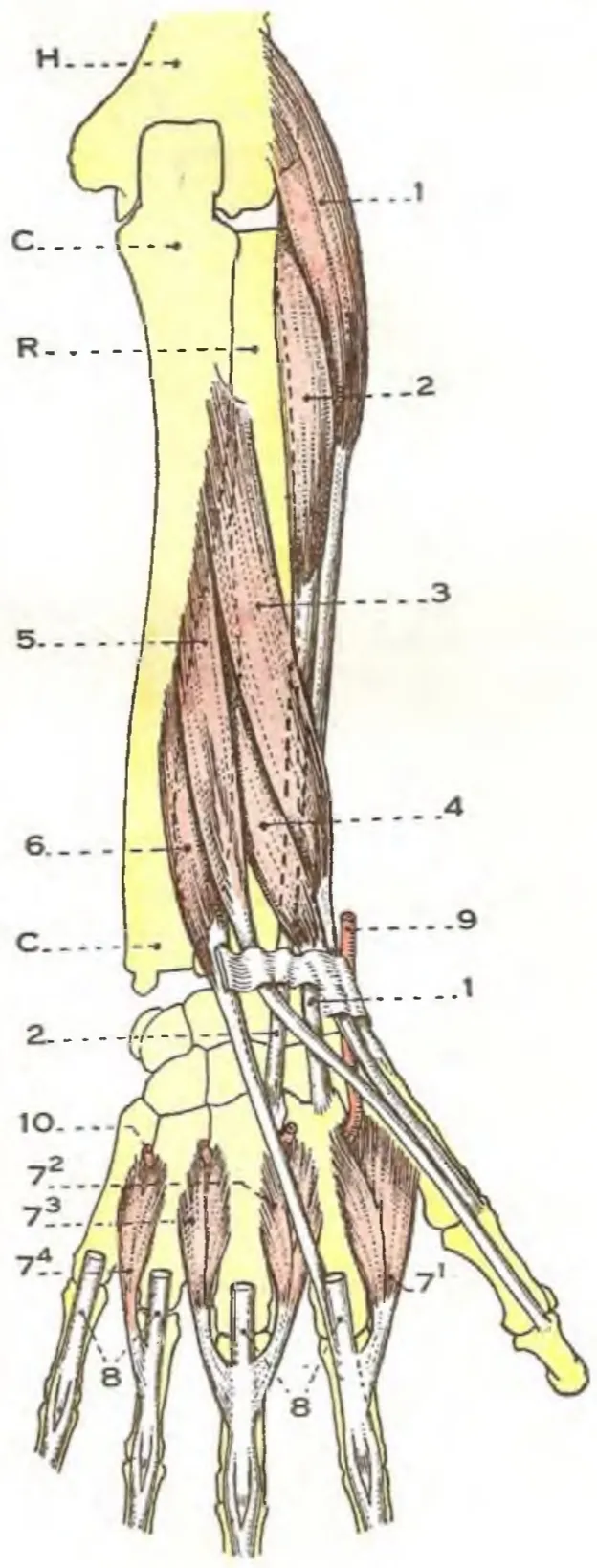
The abductor pollicis longus lies immediately below the supinator and is sometimes united with it. It arises from the lateral part of the dorsal surface of the body of the ulna, below the insertion of the anconeus, from the interosseous membrane, and from the middle third of the dorsal surface of the body of the radius.
Passing obliquely downward and lateralward, it ends in a tendon, which runs through a groove on the lateral side of the lower end of the radius, accompanied by the tendon of the extensor pollicis brevis.
The insertion is divided into a distal, superficial part and a proximal, deep part. The superficial part is inserted with one or more tendons into the radial side of the base of the first metacarpal bone, and the deep part is variably inserted into the trapezium, the joint capsule and its ligaments, and into the belly of abductor pollicis brevis (APB) or opponens pollicis.
Innervation
The abductor pollicis longus muscle is innervated by the posterior interosseous nerve, which is a continuation of the deep branch of the radial nerve after it passes through the supinator muscle. Abductor pollicis longus lies close to the radial nerve. The posterior interosseous nerve is derived from spinal segments C7 & C8.
Blood supply
Abductor pollicis longus is supplied by the posterior interosseous artery.
Variation
An accessory abductor pollicis longus (AAPL) tendon is present in more than 80% of people, and a separate muscle belly is present in 20% of people. In one study, the accessory tendon was inserted into the trapezium (41%); proximally on the abductor pollicis brevis (22%) and opponens pollicis brevis (5%); had a double insertion on the trapezium and thenar muscles (15%); or the base of the first metacarpal (1%). Up to seven tendons have been reported in rare cases.
Multiple APL tendons can be regarded as a functional advantage since injured tendons can be compensated by the healthy ones.
Function
The chief action of abductor pollicis longus is to abduct the thumb at the carpometacarpal joint, thereby moving the thumb anteriorly. It also assists in extending and rotating the thumb.
By its continued action, it helps to abduct the wrist (radial deviation) and flex the hand.
The APL insertion on the trapezium and the APB origin on the same bone is the only connection between the thumb's intrinsic and extrinsic muscles. As the thumb is brought into action, these two muscles must coordinate to keep the trapezium stable in the carpus, which is important for the proper functioning of the thumb (i.e. precision and power grip.)
Source: Wikipedia, The Free Encyclopedia · CC BY-SA 4.0
References
- Abductor pollicis longus muscle — Wikipedia, The Free EncyclopediaText from the Wikipedia article "Abductor pollicis longus muscle" (CC BY-SA 4.0); excerpted. Licence. Retrieved 2026-10-19. Revision used.
Text above is quoted from the listed sources without changes to its meaning. Image credits and licences are shown with each image. Educational information only, not medical advice.
Educational anatomy reference, not medical advice. About this content.