Appendicitis
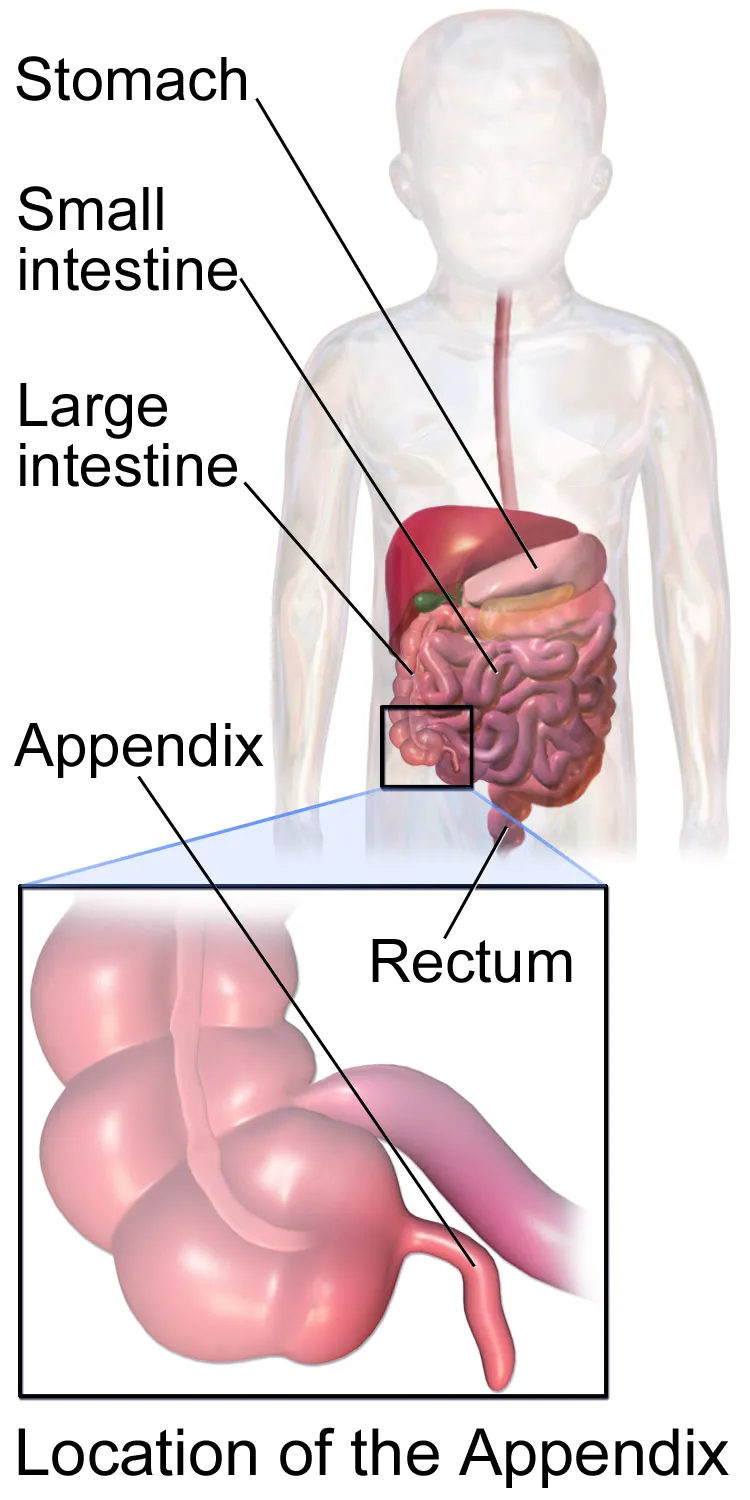
The appendix is a small, tube-like organ attached to the first part of the large intestine. It is located in the lower right part of the abdomen. It has no known function. A blockage inside of the appendix causes appendicitis. The blockage leads to increased pressure, problems with blood flow, and inflammation. If the blockage is not treated, the appendix can burst and spread infection into the abdomen. This causes a condition called peritonitis.
The main symptom is pain in the abdomen, often on the right side. It is usually sudden and gets worse over time. Other symptoms may include:
- Swelling in the abdomen
- Loss of appetite
- Nausea and vomiting
- Constipation or diarrhea
- Inability to pass gas
- Low fever
Not everyone with appendicitis has all these symptoms.
Appendicitis is a medical emergency. Treatment almost always involves removing the appendix. Anyone can get appendicitis, but it is more common among people 10 to 30 years old.
NIH: National Institute of Diabetes and Digestive and Kidney Diseases
What are the symptoms of appendicitis?
The most common symptom of appendicitis is pain in your abdomen, or belly. If you have appendicitis, the pain in your abdomen may
- begin near your belly button and move lower and to your right
- start suddenly and may even wake you if you’re sleeping
- get worse when you move around, take deep breaths, cough, or sneeze
- be severe and may feel different than any pain you’ve ever felt
- happen before other symptoms, and worsen in a matter of hours
Other symptoms of appendicitis may include
- loss of appetite
- nausea or vomiting
- fever
- swelling in your abdomen
However, some people who are found to have appendicitis, especially children, may not have any of these typical symptoms.2 Talk with your doctor right away if you or your child are experiencing pain or discomfort. A doctor can evaluate the symptoms you or your child are experiencing and provide a diagnosis or determine other possible reasons for complications.
Some people with appendicitis may also have bowel problems, such as
- an inability to pass gas
- constipation or diarrhea
- the feeling that having a bowel movement will relieve discomfort
What causes appendicitis?
Appendicitis can have more than one cause. In many cases, the cause is not clear. Possible causes include
- hardened stool or growths that can block the opening inside the appendix
- enlarged tissue in the wall of your appendix, caused by infection in the digestive tract or somewhere else in your body
- inflammatory bowel disease
When should I seek a doctor's help?
Appendicitis is a medical emergency that requires immediate care. See a doctor or go to the emergency room right away if you think you or your child has appendicitis. A doctor can help treat appendicitis, reduce symptoms, and lower the chance of complications.
Source: National Institute of Diabetes and Digestive and Kidney Diseases (NIDDK)
How do doctors diagnose appendicitis?
To diagnose appendicitis, your doctor will review your symptoms and medical history, perform a physical exam, and order lab tests and imaging tests.
Medical history
Your doctor will ask questions to help rule out other health problems. Your doctor will want to know
- when your abdominal pain began, how bad it feels, and where exactly you feel it
- when your other symptoms started
- what other medical conditions, illnesses, and operations you’ve had
- whether you use medicines or alcohol
Physical exam
During the physical exam, your doctor will check for pain in your lower-right abdomen. Your doctor may
- gently press or jiggle all areas of your abdomen
- press your right knee as you lift your leg
- flex and rotate your leg while you lie on your left side
Your doctor may also
- listen to your abdomen using a stethoscope
- do a digital rectal exam
- do a pelvic exam
Lab tests
To find out whether your abdominal pain is appendicitis or not, your doctor may order a
- blood test, which may show if you have a high white blood cell count—a sign of infection. Your blood test also may show if you have dehydration or if any fluids or electrolytes are out of balance.
- c-reactive protein (CRP) blood test to find other causes of inflammation.
- urinalysis to rule out other conditions, such as a bladder infection or a kidney stone.
- pregnancy test, if you’re a woman.
Imaging tests
Your doctor may use imaging tests to find out if your pain is caused by appendicitis.
Imaging tests can show whether your abdominal pain is caused by a blockage inside the appendix, an enlarged or burst appendix, inflammation, an abscess, or something else.
Imaging tests can also show if your abdominal pain and other symptoms are not caused by appendicitis, but rather by other conditions such as
- abdominal adhesions
- inflammatory bowel disease, including long-lasting disorders such as Crohn’s disease and ulcerative colitis
- intestinal obstruction
- pelvic inflammatory disease
- kidney stones
- problems with the reproductive system in women
Source: National Institute of Diabetes and Digestive and Kidney Diseases (NIDDK)
How do doctors treat appendicitis?
Doctors typically treat appendicitis by removing the appendix. This surgery is called an appendectomy. Surgeons perform the operation with general anesthesia in a hospital. Your doctor will recommend surgery if you have ongoing or long-lasting abdominal pain and fever, or if you show signs of a burst appendix and infection. Prompt surgery decreases the chances that your appendix will burst and cause additional health complications.
A surgeon removes your appendix either by
- laparoscopic surgery, in which the surgeon makes a small incision, or cut, in the abdomen and inserts a laparoscope—a thin tube with a tiny video camera and light attached—to view the inside of your abdomen. Surgeons may make one or more additional small incisions and insert tools to remove or repair organs and tissues.
- open laparotomy, in which the surgeon uses a single, larger incision in the lower-right area of your abdomen.
Laparoscopic surgery is becoming increasingly common. It generally leads to fewer complications, such as hospital-related infections, and it has a shorter recovery time. After examining your condition and past medical history, your surgeon will recommend the best method for you.
What if the surgeon finds a normal appendix?
In some cases, a surgeon may find a normal appendix during surgery. If this happens, some surgeons usually remove the appendix so you don’t develop appendicitis in the future. Sometimes surgeons find a different problem, and they may correct it during surgery.
Can doctors treat appendicitis without surgery?
Anyone who might have appendicitis is treated with antibiotics before surgery. Some people may improve with the antibiotics and not need surgery.
Some mild cases of appendicitis may be treated with antibiotics alone. Researchers are studying who might safely avoid surgery based on their symptoms, test results, health, and age, but surgery remains the standard of care.
How do doctors treat complications of a burst appendix?
Treating the complications of a burst appendix will depend on which complication develops: peritonitis or an abscess.
Peritonitis
If you don’t get treated quickly, peritonitis can threaten your life. In most cases, a surgeon will immediately perform a laparotomy: first, to clean the inside of your abdomen to prevent infection, and then to remove your appendix.
Abscess
Doctors typically drain the pus from an abscess to allow it to heal.
What complications may occur after an appendectomy?
Surgery to remove your appendix is generally safe. However, complications are possible. Complications after laparoscopic surgery or open laparotomy may include
- infection of the surgical site
- an abscess that forms inside your abdomen
- a fistula, or abnormal passage, that forms between your intestine or stomach and your skin
- a small bowel obstruction
- ileus, a condition in which your bowel does not work correctly
- abdominal adhesions, or bands of scar-like tissue that form inside your abdomen
What should I expect after surgery to treat appendicitis?
After surgery, you will likely recover completely from appendicitis and won’t need to make changes to your diet, exercise, or lifestyle. Surgeons generally recommend you limit physical activity for the first 3 to 5 days after laparoscopic surgery and for the first 10 to 14 days after a laparotomy. Talk with your surgeon about your recovery plan.
This content is provided as a service of the National Institute of Diabetes and Digestive and Kidney Diseases (NIDDK), part of the National Institutes of Health. NIDDK translates and disseminates research findings to increase knowledge and understanding about health and disease among patients, health professionals, and the public. Content produced by NIDDK is carefully reviewed by NIDDK scientists and other experts.
Source: National Institute of Diabetes and Digestive and Kidney Diseases (NIDDK)
References
- Appendicitis — MedlinePlus, U.S. National Library of MedicineSource: MedlinePlus, National Library of Medicine Public domain (U.S. government work). Retrieved 2026-10-19.
- Symptoms & Causes of Appendicitis - NIDDK — National Institute of Diabetes and Digestive and Kidney Diseases (NIDDK)Source: National Institute of Diabetes and Digestive and Kidney Diseases (NIDDK). Use does not imply endorsement. Public domain (U.S. government work). Retrieved 2026-10-19.
- Diagnosis of Appendicitis - NIDDK — National Institute of Diabetes and Digestive and Kidney Diseases (NIDDK)Source: National Institute of Diabetes and Digestive and Kidney Diseases (NIDDK). Use does not imply endorsement. Public domain (U.S. government work). Retrieved 2026-10-19.
- Treatment for Appendicitis - NIDDK — National Institute of Diabetes and Digestive and Kidney Diseases (NIDDK)Source: National Institute of Diabetes and Digestive and Kidney Diseases (NIDDK). Use does not imply endorsement. Public domain (U.S. government work). Retrieved 2026-10-19.
Text above is quoted from the listed sources without changes to its meaning. Image credits and licences are shown with each image. Educational information only, not medical advice.
Related conditions
Educational overview, not medical advice. Treatment varies by person and location. Consult a qualified health professional for diagnosis or care. Content and model notes · Privacy information