Appendix
Appendix vermiformis
View the appendix in 3DIn the human body, the appendix (pl.: appendices or appendixes; also vermiform appendix; cecal (or caecal, cæcal) appendix; vermix; or vermiform process) is a finger-like, blind-ended tube connected to the cecum.
The cecum is a pouch-like structure of the large intestine, located at the junction of the small and the large intestines. The term "vermiform" comes from Latin and means "worm-shaped".
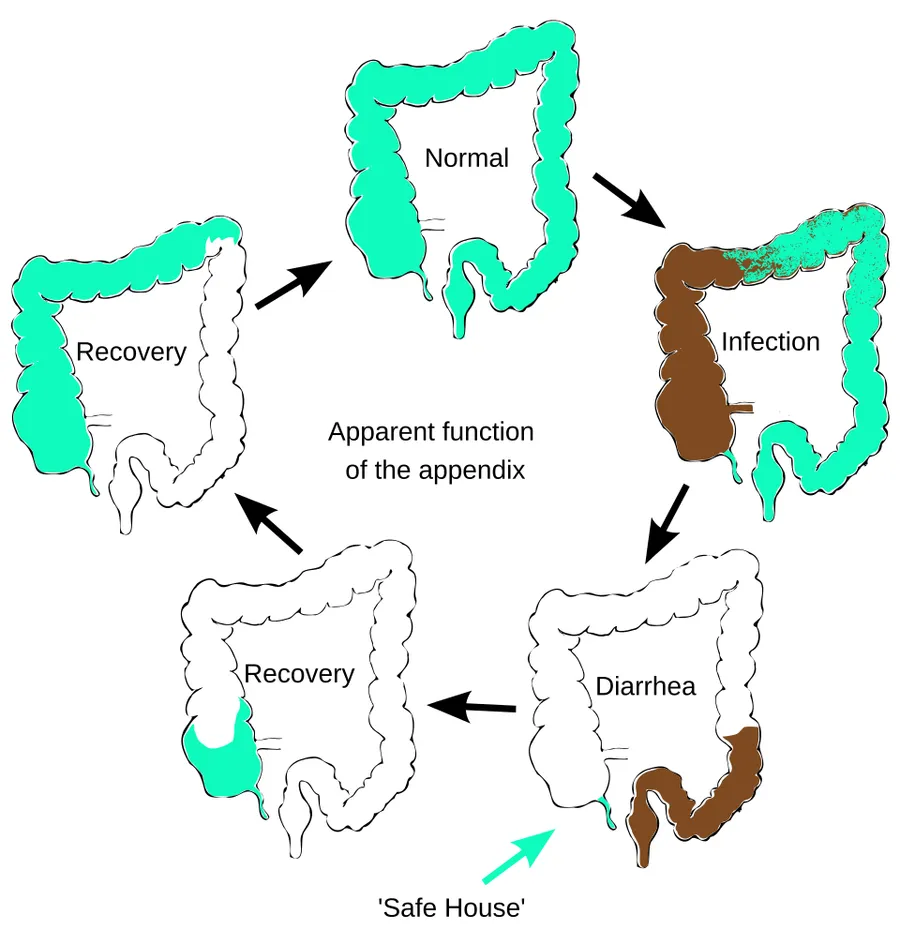
The function of the appendix has long been unclear, and if it becomes inflamed (appendicitis), doctors may surgically remove it (appendectomy). Since the early 2000s, extensive work has been conducted regarding potential functions of the appendix (for example, serving as a reservoir for beneficial gut bacteria).
Structure
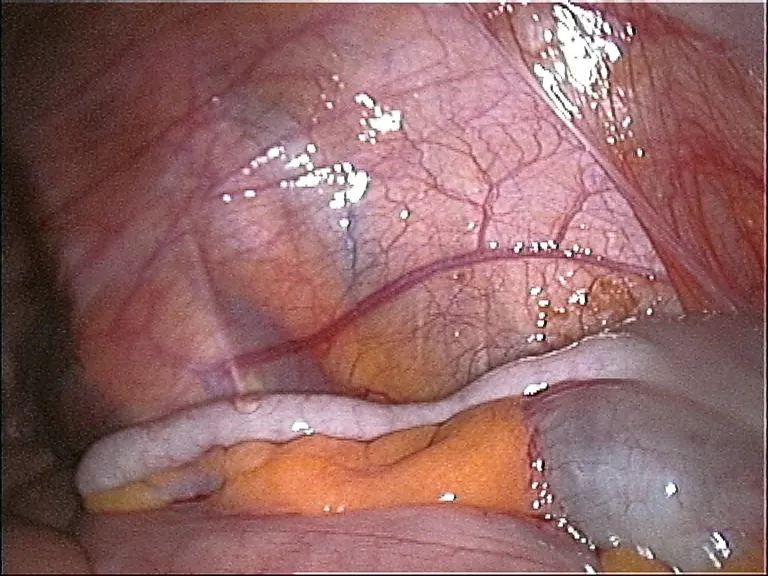
The human appendix averages 9 mm (0.35 in) in length, ranging from 5 to 35 mm (0.20 to 1.38 in). The diameter of the appendix is 6 mm (0.24 in); any larger is considered a thickened or inflamed appendix. The appendix is usually located in the lower right quadrant of the abdomen, near the right hip bone. The base of the appendix is located 2 cm (0.79 in) beneath the ileocecal valve that separates the large intestine from the small intestine. Its position within the abdomen corresponds to a point on the surface known as McBurney's point.
The appendix is connected to the mesentery in the lower region of the ileum, by a short region of the mesocolon known as the mesoappendix.
Variation
Some identical twins – known as mirror image twins – can have a mirror-imaged anatomy, a congenital condition where one has the appendix located in the lower left quadrant of the abdomen instead of the lower right. Intestinal malrotation may also cause displacement of the appendix to the left side.
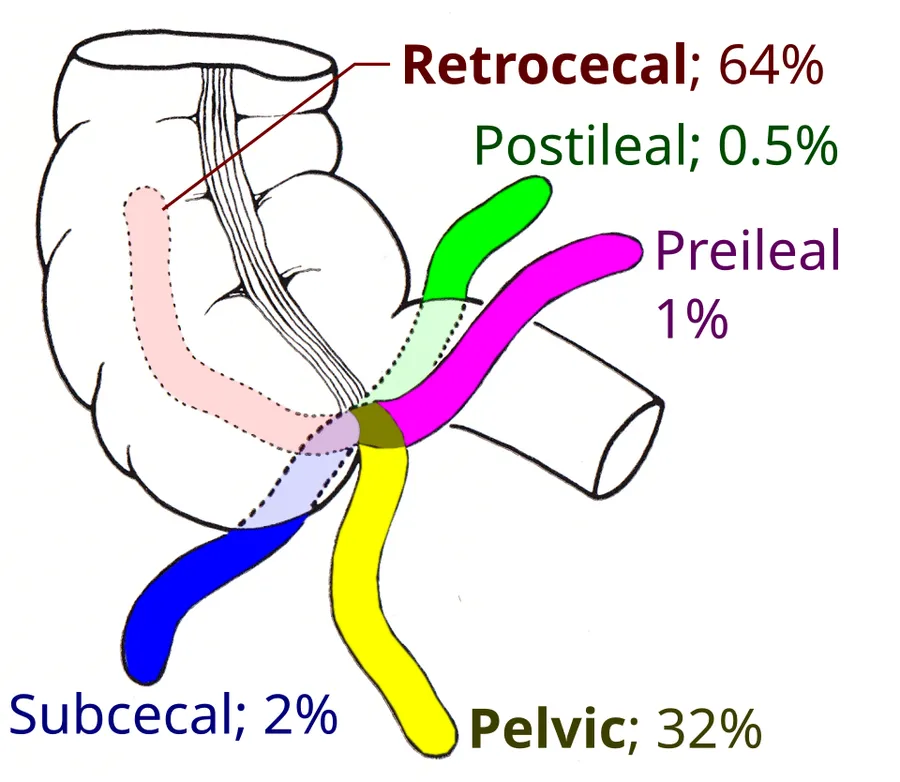
While the base of the appendix is typically located 2 cm (0.79 in) below the ileocecal valve, the tip of the appendix can be variably located–in the pelvis, outside the peritoneum or behind the cecum. The prevalence of the different positions varies amongst populations for example, the retrocecal position is most common in Ghana and Sudan, with 67.3% and 58.3% occurrence respectively, in comparison to Iran and Bosnia where the pelvic position is most common, with 55.8% and 57.7% occurrence respectively.
In rare cases, the appendix may be absent (laparotomies for suspected appendicitis have given a frequency of 1 in 100,000).
Sometimes a semi-circular fold of mucous membrane appears at the opening of the appendix. This valve of the vermiform appendix is also called Gerlach's valve.
Source: Wikipedia, The Free Encyclopedia · CC BY-SA 4.0
References
- Appendix (anatomy) — Wikipedia, The Free EncyclopediaText from the Wikipedia article "Appendix (anatomy)" (CC BY-SA 4.0); excerpted. Licence. Retrieved 2026-10-19. Revision used.
Text above is quoted from the listed sources without changes to its meaning. Image credits and licences are shown with each image. Educational information only, not medical advice.
Related conditions
Educational anatomy reference, not medical advice. About this content.