Vas deferens
Ductus deferens sinistra
- Paired structure: one on the left and one on the right side of the body.
The vas deferens (pl.: vasa deferentia), ductus deferens (pl.: ductūs deferentes), or sperm duct is part of the male reproductive system of many vertebrates. In mammals, spermatozoa are produced in the seminiferous tubules and flow into the epididymal duct. The end of the epididymis is connected to the vas deferens. The vas deferens ends with an opening into the ejaculatory duct at a point where the duct of the seminal vesicle also joins the ejaculatory duct.
The vas deferens is a partially coiled tube which exits the abdominal cavity through the inguinal canal.
Structure
The human vas deferens measures 30–35 cm in length, and 2–3 mm in diameter. It is continuous proximally with the tail of the epididymis, and exhibits a tortuous, convoluted initial/proximal section (which measures 2–3 cm in length). Distally, it forms a dilated and tortuous segment termed the ampulla of vas deferens before ending by uniting with a duct of the seminal vesicle to form the ejaculatory duct. Together they form part of the spermatic cord.
Blood supply
The vasa deferentia are supplied with blood by accompanying arteries, the (arteries of vas deferens). These arteries normally arises from the superior (sometimes inferior) vesical arteries, a branch of the internal iliac arteries.
Innervation
The vas deferens receives innervation from an autonomic plexus of post-ganglionic sympathetic fibres derived from the inferior hypogastric plexus.
It is innervated by a variety of nerve endings, although of the efferent nerves the sympathetic innervation dominates. Adrenergic junctions (those which release noradrenaline) are found in the smooth muscle layers. Cholinergic synapses and vasoactive intestinal peptide synapses are found in the connective tissue of the mucosa.
Anatomical relations
Within the spermatic cord, the vas deferens is situated posterior (and parallel to) the vessels of the spermatic cord.
The vas deferens traverses the inguinal canal to reach the pelvic cavity; it enters the pelvic cavity lateral to the inferior epigastric vessels. At the deep inguinal ring, the vas deferens diverges from the testicular vessels to pass medially to reach the base of the prostate posteriorly.
Histology
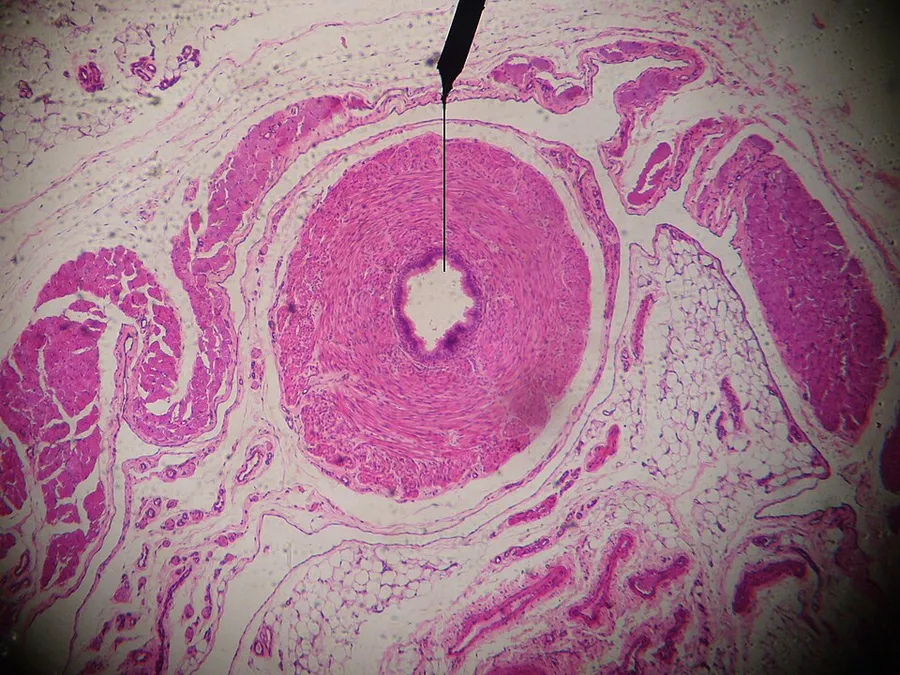
The vas deferens consists of an external adventitial sheath containing blood vessels and nerves, a muscular middle layer composed of three layers of smooth muscle (with a circular muscle layer interposed between two longitudinal muscle layers), and an internal mucosal lining consisting of pseudostratified columnar epithelium (which bears the non-motile stereocilia).
The vas deferens has the greatest muscle-to-lumen ratio of any hollow organ.
Function
During ejaculation, the smooth muscle in the walls of the vas deferens contracts reflexively, thus propelling the sperm forward. This is also known as peristalsis. The epithelial sodium channel ENaC is strongly expressed in smooth muscle cells of the vas deferens. It has been suggested that ENaC functions as a mechanosensor in vascular smooth muscle cells that initiate pressure‐induced constriction known as the "myogenic response". Ion channels ENaC and CFTR, aquaporin of type AQP9 are localized on the apical border of the epithelia. Thus, these channels are involved concurrently in the regulation of fluid and electrolyte balance in the lumen of the vas deferens.
The sperm are transferred from each vas deferens into the urethra, partially mixing with secretions from the male accessory sex glands such as the seminal vesicles, prostate gland and the bulbourethral glands, which form the bulk of semen.
Clinical significance
Damage to the vas deferens during inguinal hernia repair may cause infertility.
Contraception
A vasectomy is a method of contraception in which the vasa deferentia are permanently cut. In some cases, it can be reversed. A modern variation, vas-occlusive contraception, involves injecting an obstructive material into the ductus to block the flow of sperm.
Disease
The vas deferens may be obstructed, or it may be completely absent in a condition known as congenital absence of the vas deferens (CAVD, a potential feature of cystic fibrosis), causing male infertility. Acquired obstructions can occur due to infections. To treat these causes of male infertility, sperm can be harvested by testicular sperm extraction (TESE) or microsurgical epididymal sperm aspiration (MESA).
Source: Wikipedia, The Free Encyclopedia · CC BY-SA 4.0
References
- Vas deferens — Wikipedia, The Free EncyclopediaText from the Wikipedia article "Vas deferens" (CC BY-SA 4.0); excerpted. Licence. Retrieved 2026-10-19. Revision used.
Text above is quoted from the listed sources without changes to its meaning. Image credits and licences are shown with each image. Educational information only, not medical advice.
Related conditions
Educational anatomy reference, not medical advice. About this content.