Fungal skin infections (tinea)
Also called: Ringworm, Athlete's foot, Tinea
Athlete's foot is a common infection caused by a fungus. It most often affects the space between the toes. Symptoms include itching, burning, and cracked, scaly skin between your toes.
You can get athlete's foot from damp surfaces, such as showers, swimming pools, and locker room floors. To prevent it:
- Keep your feet clean, dry, and cool
- Wear clean socks
- Don't walk barefoot in public areas
- Wear flip-flops in locker room showers
- Keep your toenails clean and clipped short
Treatments include over-the-counter antifungal creams for most cases and prescription medicines for more serious infections. These usually clear up the infection, but it can come back.
Centers for Disease Control and Prevention
Types
A number of different species of fungus are involved in dermatophytosis. Dermatophytes of the genera Trichophyton and Microsporum are the most common causative agents. These fungi attack various parts of the body and lead to the conditions listed below. The Latin names are for the conditions (disease patterns), not the agents that cause them. The disease patterns below identify the type of fungus that causes them only in the cases listed:
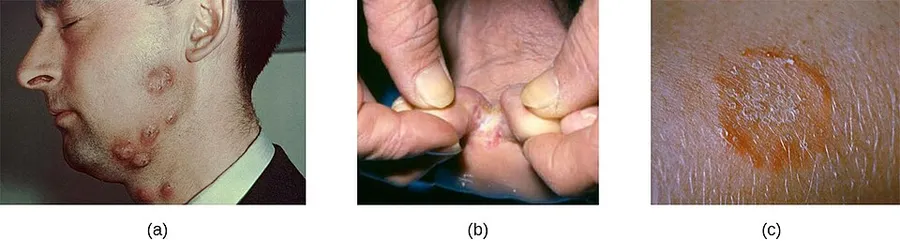
Tinea pedis (athlete's foot): fungal infection of the feet
Tinea unguium: fungal infection of the fingernails and toenails, and the nail bed
Tinea corporis: fungal infection of the arms, legs, and trunk
Tinea cruris (jock itch): fungal infection of the groin area
Tinea manuum: fungal infection of the hands and palm area
Tinea capitis: fungal infection of the scalp and hair
Tinea faciei (face fungus): fungal infection of the face
Tinea barbae: fungal infestation of facial hair
Other superficial mycoses (not classic ringworm, since not caused by dermatophytes)
Tinea versicolor: caused by Malassezia furfur
Signs and symptoms
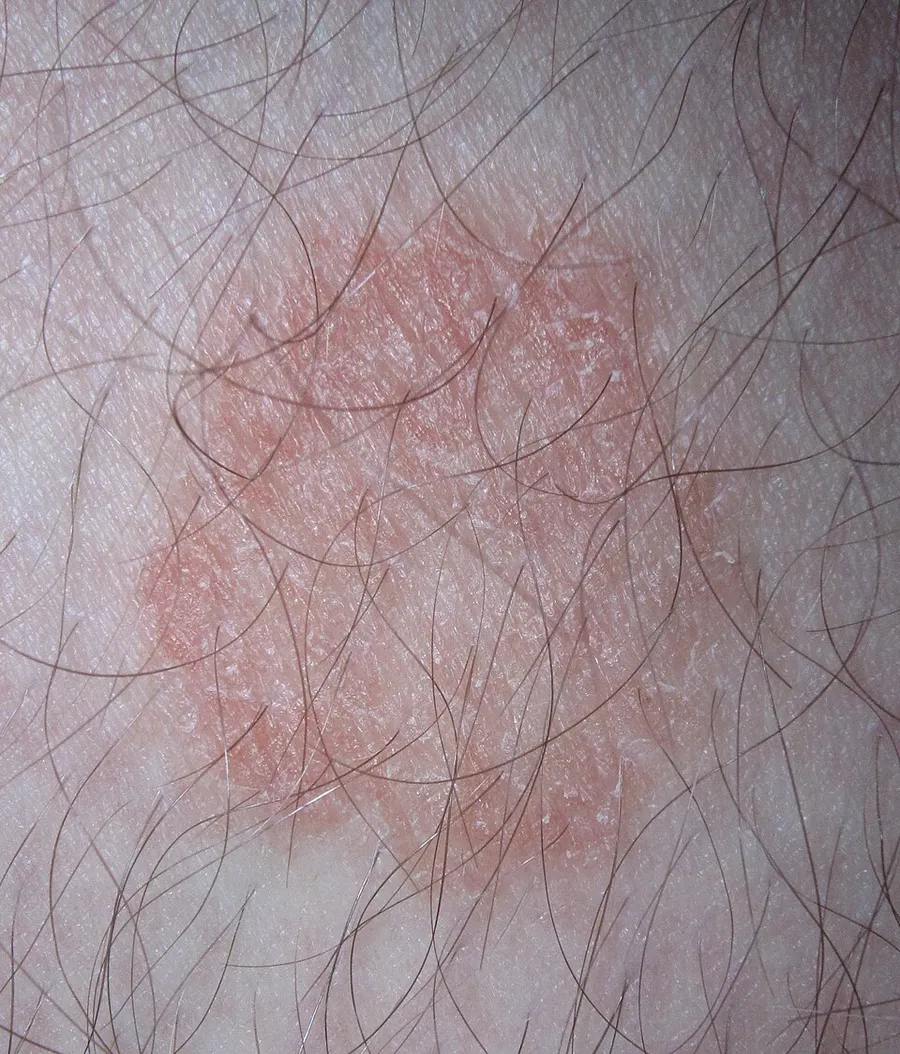
Infections on the body may give rise to typical enlarging raised red rings of ringworm. Infection on the skin of the feet may cause athlete's foot and in the groin, jock itch. Involvement of the nails is termed onychomycosis.
Animals including dogs and cats can also be affected by ringworm, and the disease can be transmitted between animals and humans, making it a zoonotic disease.
patches may be redder on outside edges or resemble a ring
patches that begin to ooze or develop a blister
bald patches may develop when the scalp is affected
Causes
Fungi thrive in moist, warm areas, such as locker rooms, tanning beds, swimming pools, and skin folds; accordingly, those that cause dermatophytosis may be spread by using exercise machines that have not been disinfected after use, or by sharing towels, clothing, footwear, or hairbrushes.
Diagnosis
Dermatophyte infections can be readily diagnosed based on the history, physical examination, and potassium hydroxide (KOH) microscopy.
Prevention
Avoid sharing clothing, sports equipment, towels, or sheets.
Wash clothes in hot water with fungicidal soap after suspected exposure to ringworm.
Avoid walking barefoot; instead wear appropriate protective shoes in locker rooms and sandals at the beach.
Avoid touching pets with bald spots, as they are often carriers of the fungus.
Vaccination
As of 2016, no approved human vaccine currently exists against dermatophytosis. For horses, dogs and cats there is available an approved inactivated vaccine called Insol Dermatophyton (Boehringer Ingelheim) which provides time-limited protection against several trichophyton and microsporum fungal strains. With cattle, systemic vaccination has achieved effective control of ringworm. Since 1979 a Russian live vaccine (LFT 130) and later on a Czechoslovak live vaccine against bovine ringworm has been used. In Scandinavian countries vaccination programmes against ringworm are used as a preventive measure to improve the hide quality. In Russia, fur-bearing animals (silver fox, foxes, polar foxes) and rabbits have also been treated with vaccines.
Treatment
Antifungal treatments include topical agents such as miconazole, terbinafine, clotrimazole, ketoconazole, or tolnaftate applied twice daily until symptoms resolve — usually within one or two weeks. Topical treatments should then be continued for a further 7 days after resolution of visible symptoms to prevent recurrence. The total duration of treatment is therefore generally two weeks, but may be as long as three.
In more severe cases or scalp ringworm, systemic treatment with oral medications (such as itraconazole, terbinafine, and ketoconazole) may be given.
To prevent spreading the infection, lesions should not be touched, and good hygiene maintained with washing of hands and the body.
Misdiagnosis and treatment of ringworm with a topical steroid, a standard treatment of the superficially similar pityriasis rosea, can result in tinea incognito, a condition where ringworm fungus grows without typical features, such as a distinctive raised border.
Epidemiology
Worldwide, superficial fungal infections caused by dermatophytes are estimated to infect around 20-25% of the population and it is thought that dermatophytes infect 10-15% of the population during their lifetime. The highest incidence of superficial mycoses result from dermatophytoses which are most prevalent in tropical regions. Onychomycosis, a common infection caused by dermatophytes, is found with varying prevalence rates in many countries. Tinea pedis + onychomycosis, Tinea corporis, Tinea capitis are the most common dermatophytosis found in humans across the world. Tinea capitis has a greater prevalence in children. The increasing prevalence of dermatophytes resulting in Tinea capitis has been causing epidemics throughout Europe and America. In pets, cats are the most affected by dermatophytosis. Pets are susceptible to dermatophytoses caused by Microsporum canis, Microsporum gypseum, and Trichophyton. For dermatophytosis in animals, risk factors depend on age, species, breed, underlying conditions, stress, grooming, and injuries.
Numerous studies have found Tinea capitis to be the most prevalent dermatophyte to infect children across the continent of Africa. Dermatophytosis has been found to be most prevalent in children ages 4 to 11, infecting more males than females. Low socioeconomic status was found to be a risk factor for Tinea capitis. Throughout Africa, dermatophytoses are common in hot- humid climates and with areas of overpopulation.
Chronicity is a common outcome for dermatophytosis in India. The prevalence of dermatophytosis in India is between 36.6 and 78.4% depending on the area, clinical subtype, and dermatophyte isolate. Individuals ages 21–40 years are most commonly affected.
A 2002 study looking at 445 samples of dermatophytes in patients in Goiânia, Brazil found the most prevalent type to be Trichophyton rubrum (49.4%), followed by Trichophyton mentagrophytes (30.8%), and Microsporum canis (12.6%).
A 2013 study looking at 5,175 samples of Tinea in patients in Tehran, Iran found the most prevalent type to be Tinea pedis (43.4%), followed by Tinea unguium. (21.3%), and Tinea cruris (20.7%).
Source: Wikipedia, The Free Encyclopedia · CC BY-SA 4.0
References
- Athlete's Foot — MedlinePlus, U.S. National Library of MedicineSource: MedlinePlus, National Library of Medicine Public domain (U.S. government work). Retrieved 2026-10-19.
- Dermatophytosis — Wikipedia, The Free EncyclopediaText from the Wikipedia article "Dermatophytosis" (CC BY-SA 4.0); excerpted. Licence. Retrieved 2026-10-19. Revision used.
Text above is quoted from the listed sources without changes to its meaning. Image credits and licences are shown with each image. Educational information only, not medical advice.
Related conditions
Educational overview, not medical advice. Treatment varies by person and location. Consult a qualified health professional for diagnosis or care. Content and model notes · Privacy information