Serratus anterior
M. serratus anterior
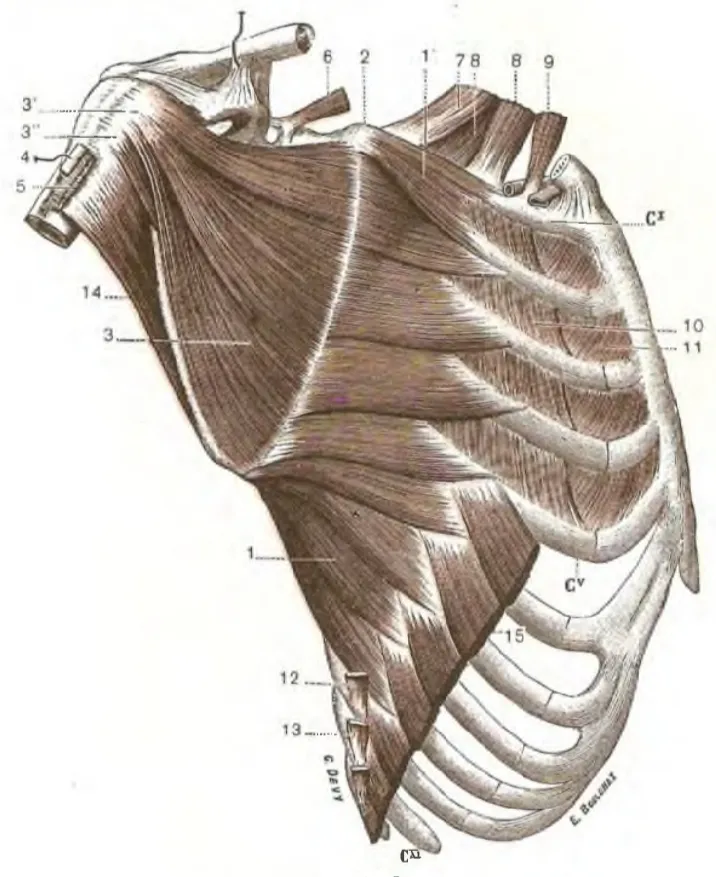
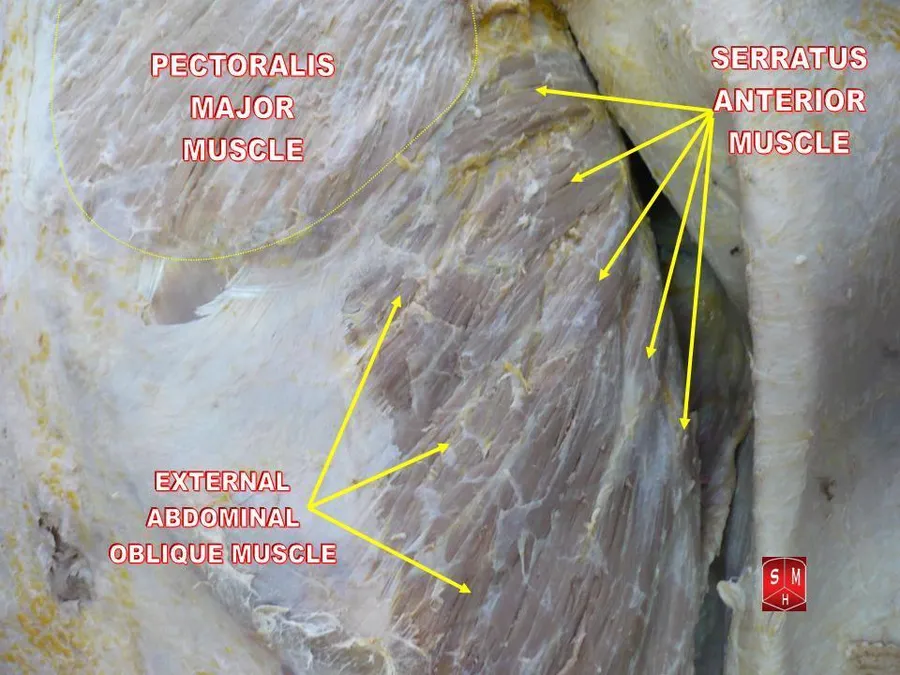
View the serratus anterior in 3DThe serratus anterior, also known as serratus magnus, is a muscle of the chest. It originates at the side of the chest from the upper 9 ribs; it inserts along the entire length of the anterior aspect of the medial border of the scapula. It is innervated by the long thoracic nerve from the brachial plexus. The serratus anterior acts to pull the scapula forward around the thorax.
The muscle is named from Latin: serrare = to saw (referring to the shape); and anterior = on the front side of the body.
Origin
Serratus anterior typically originates by ten muscle slips – arising from the 1st to 9th ribs; because two slips arise from the 2nd rib, the number of slips is greater than the number of ribs from which they originate.
Insertion
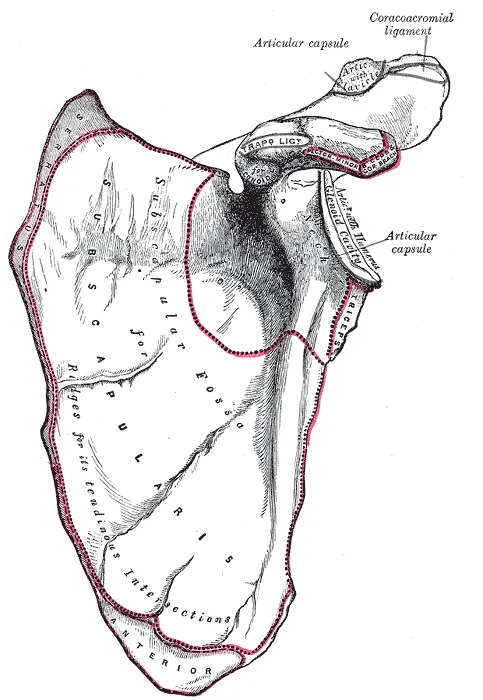
The muscle is inserted along the medial border of the scapula between the superior and inferior angle of the scapula.
The muscle is divided into three parts according to the points of insertion:
the serratus anterior superior is inserted near the superior angle;
the serratus anterior intermediate is inserted along the medial border;
the serratus anterior inferior is inserted near the inferior angle.
Innervation
The serratus anterior is innervated by the long thoracic nerve, a branch of the brachial plexus. The long thoracic nerve travels inferiorly on the surface of the serratus anterior muscle.
Relations
The serratus anterior lies deep to the subscapularis, from which it is separated by the subscapularis (supraserratus) bursa. It is separated from the rib by the scapulothoracic (infraserratus) bursa.
Function
All three parts described above pull the scapula forward around the thorax, which is essential for anteversion of the arm. As such, the muscle is an antagonist to the rhomboids. However, when the inferior and superior parts act together, they keep the scapula pressed against the thorax together with the rhomboids and therefore these parts also act as synergists to the rhomboids. The inferior part can pull the lower end of the scapula laterally and forward and thus rotates the scapula to make elevation of the arm possible. Additionally, all three parts can lift the ribs when the shoulder girdle is fixed, and thus assist in respiration.
The serratus anterior is occasionally called the "big swing muscle" or "boxer's muscle" because it is largely responsible for the protraction of the scapula—that is, the pulling of the scapula forward and around the rib cage that occurs when someone throws a punch.
The serratus anterior acts in concert with the upper and lower fibers of the trapezius muscle to sustain upward rotation of the scapula, which allows for overhead lifting.
Clinical significance
The long thoracic nerve that supplies the serratus anterior muscle is vulnerable during certain types of surgery (for example, during lymph node clearance from the axilla for breast cancer). Damage to this nerve is the most common cause of winged scapula.
Source: Wikipedia, The Free Encyclopedia · CC BY-SA 4.0
References
- Serratus anterior muscle — Wikipedia, The Free EncyclopediaText from the Wikipedia article "Serratus anterior muscle" (CC BY-SA 4.0); excerpted. Licence. Retrieved 2026-10-19. Revision used.
Text above is quoted from the listed sources without changes to its meaning. Image credits and licences are shown with each image. Educational information only, not medical advice.
Educational anatomy reference, not medical advice. About this content.