Nasal bone
Os nasale sinistrum
- Paired structure: one on the left and one on the right side of the body.
The nasal bones are two small oblong bones, varying in size and form in different individuals; they are placed side by side at the middle and upper part of the face and by their junction, form the bridge of the upper one third of the nose.
In humans, each has two surfaces and four borders.
Structure
There is heavy variation in the structure of the nasal bones, accounting for the differences in sizes and shapes of the nose seen across different people. Angles, shapes, and configurations of both the bone and cartilage are heavily varied between individuals. Broadly, most nasal bones can be categorized as "V-shaped" or "S-shaped" but these are not scientific or medical categorizations. When viewing anatomical drawings of these bones, consider that they are unlikely to be accurate for a majority of people.
The two nasal bones are joined at the midline internasal suture and make up the bridge of the nose.
Surfaces
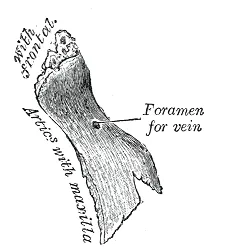
The outer surface is concavo-convex from above downward, convex from side to side; it is covered by the procerus and nasalis muscles, and perforated about its center by the nasal foramen, a small passageway for the transmission of a small vein from the overlying soft tissues.
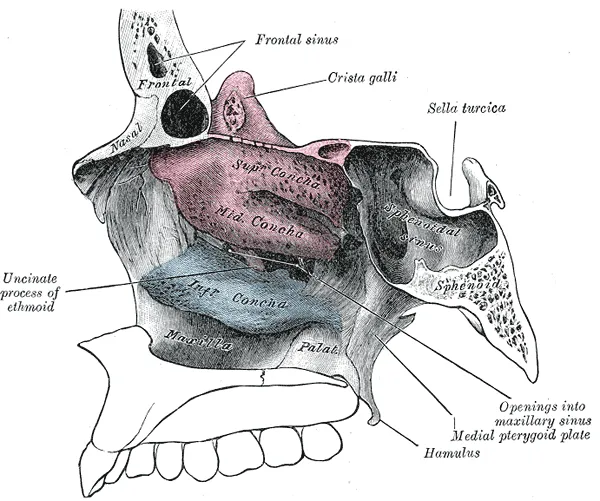
The inner surface is concave from side to side, and is traversed from above downward, by a groove for the passage of a branch of the nasociliary nerve.
Articulations
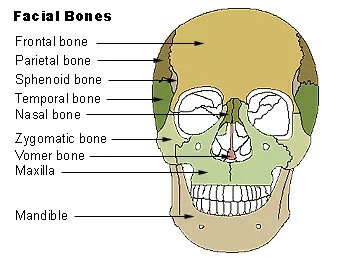
The nasal articulates with four bones: two of the cranium, the frontal and ethmoid, and two of the face, the opposite nasal and the maxilla.
Source: Wikipedia, The Free Encyclopedia · CC BY-SA 4.0
References
- Nasal bone — Wikipedia, The Free EncyclopediaText from the Wikipedia article "Nasal bone" (CC BY-SA 4.0); excerpted. Licence. Retrieved 2026-10-19. Revision used.
Text above is quoted from the listed sources without changes to its meaning. Image credits and licences are shown with each image. Educational information only, not medical advice.
Educational anatomy reference, not medical advice. About this content.