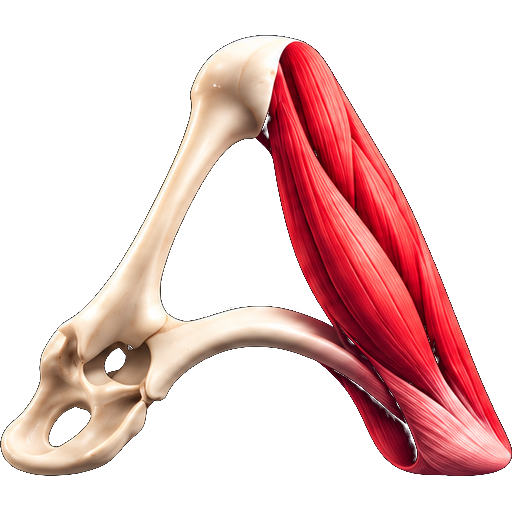
Hip bone
Os coxae sinistrum
- Paired structure: one on the left and one on the right side of the body.
The hip bone (os coxae, innominate bone, or coxal bone) is a large flat bone, constricted in the center and expanded above and below. In some vertebrates (including humans before puberty) it is composed of three parts: the ilium, ischium, and the pubis.
The two hip bones join at the pubic symphysis and together with the sacrum and coccyx (the pelvic part of the spine) comprise the skeletal component of the pelvis – the pelvic girdle which surrounds the pelvic cavity. They are connected to the sacrum, which is part of the axial skeleton, at the sacroiliac joint. Each hip bone is connected to the corresponding femur (thigh bone) (forming the primary connection between the bones of the lower limb and the axial skeleton) through the large ball and socket joint of the hip.
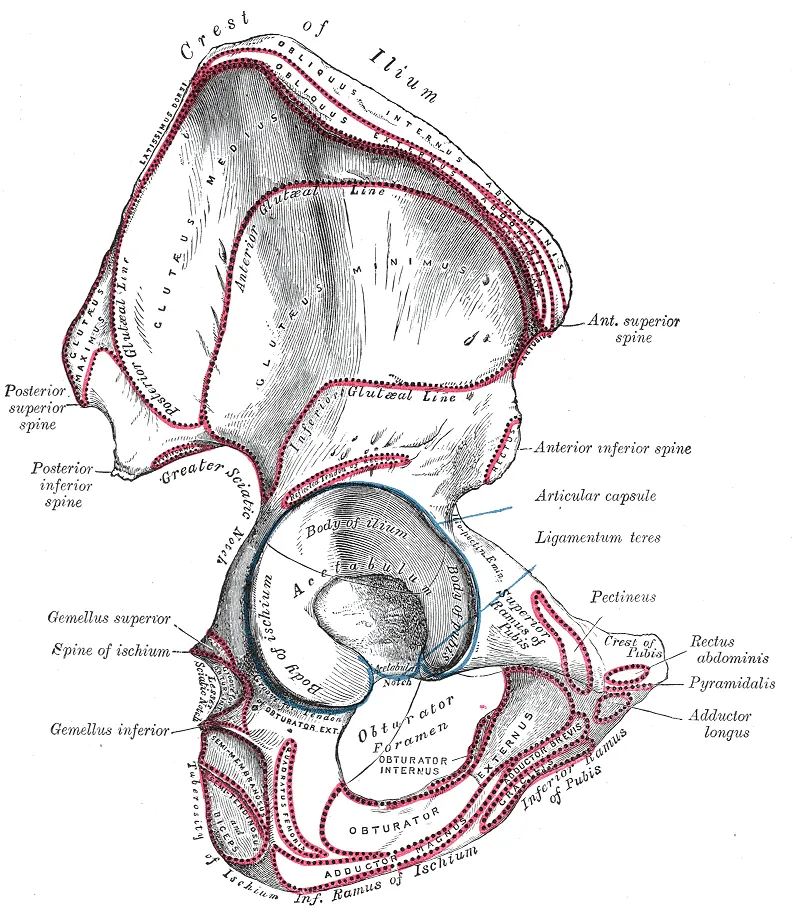
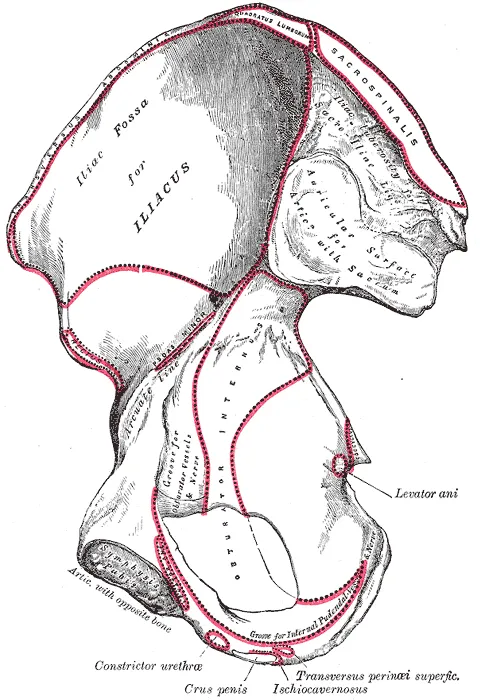
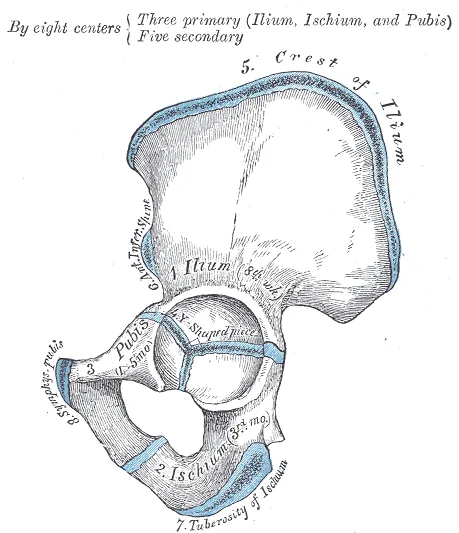
Structure
The hip bone is formed by three parts: the ilium, ischium, and pubis. At birth, these three components are separated by hyaline cartilage. They join each other in a Y-shaped portion of cartilage in the acetabulum. By the end of puberty the three regions will have fused together, and by the age 25 they will have ossified.
The two hip bones join each other at the pubic symphysis. Together with the sacrum and coccyx, the hip bones form the pelvis.
Ilium
Ilium (plural ilia) is the uppermost and largest region. It makes up two fifths of the acetabulum. It is divisible into two parts: the body and the ala or wing of ilium; the separation is indicated on the top surface by a curved line, the arcuate line, and on the external surface by the margin of the acetabulum. The body of ilium forms the sacroiliac joint with the sacrum. The superior edge of the wing of ilium forms the S-shaped iliac crest which is easily located through the skin. The iliac crest shows clear marks of the attachment of the three abdominal wall muscles.
Ischium
The ischium forms the lower and back part of the hip bone and is located below the ilium and behind the pubis. The ischium is the strongest of the three regions that form the hip bone. It is divisible into three portions: the body, the superior ramus, and the inferior ramus. The body forms approximately one-third of the acetabulum.
The ischium forms a large swelling, the tuberosity of the ischium, also referred to colloquially as the "sit bone". When sitting, the weight is frequently placed upon the ischial tuberosity. The gluteus maximus covers it in the upright posture, but leaves it free in the seated position.
Pubis
The pubic region or pubis is the ventral and anterior of the three parts forming the hip bone. It is divisible into a body, a superior ramus, and an inferior ramus. The body forms one-fifth of the acetabulum. The body forms the wide, strong, medial and flat portion of the pubic bone which unites with the other pubic bone in the pubic symphysis. The fibrocartilaginous pad which lies between the symphysial surfaces of the coxal bones, that secures the pubic symphysis, is called the interpubic disc.
Pelvic brim
The pelvic brim is a continuous oval ridge of bone that runs along the pubic symphysis, pubic crests, arcuate lines, sacral alae, and sacral promontory.
False pelvis, pelvic inlet, and ramus
The false pelvis is that portion superior to the pelvic brim; it is bounded by the alae of the ilia laterally and the sacral promontory and lumbar vertebrae posteriorly.
The true pelvis is the region inferior to the pelvic brim that is almost entirely surrounded by bone.
The pelvic inlet is the opening delineated by the pelvic brim. The widest dimension of the pelvic inlet is from left to right, that is, along the frontal plane. The pelvic outlet is the margin of the true pelvis. It is bounded anteriorly by the pubic arch, laterally by the ischia, and posteriorly by the sacrum and coccyx.
The superior pubic ramus is a part of the pubic bone which forms a portion of the obturator foramen. It extends from the body to the median plane where it articulates with its fellow of the opposite side. It is conveniently described in two portions: a medial flattened part and a narrow lateral prismoid portion. The inferior pubic ramus is thin and flat. It passes laterally and downward from the medial end of the superior ramus. It becomes narrower as it descends and joins with the inferior ramus of the ischium below the obturator foramen.
Fractures
Fractures of the hip bone are termed pelvic fractures, and should not be confused with hip fractures, which are actually femoral fractures that occur in the proximal end of the femur.
Preparation for childbirth
Pelvimetry is the assessment of the female pelvis in relation to the birth of a baby in order to detect an increased risk for obstructed labor.
Source: Wikipedia, The Free Encyclopedia · CC BY-SA 4.0
References
- Hip bone — Wikipedia, The Free EncyclopediaText from the Wikipedia article "Hip bone" (CC BY-SA 4.0); excerpted. Licence. Retrieved 2026-10-19. Revision used.
Text above is quoted from the listed sources without changes to its meaning. Image credits and licences are shown with each image. Educational information only, not medical advice.
Related conditions
Educational anatomy reference, not medical advice. About this content.